
Skincare that asks why.
Ancient botanicals, examined through a modern scientific lens.
Four starting points. Care shaped around your skin.
A natural, water-free formulation philosophy.
See beneath the surface

Water droplets slowly evaporate into the surroundings. After they disappear, the upper skin cells gently compress.
Developed by Raghottam Katti Master’s in Chemistry · Former IISc researcher
01
Cause-based
Four useful starting points. Fewer decisions.
02
Water-free
Built around botanical oils and natural lipids.
03
Nothing to hide
Every ingredient, clearly disclosed.
START WITH UNDERSTANDING
Many concerns.
Four starting points.
Skin is complex. Your first step can be simple. Explore the four care categories behind our formulations.
Hover over a cause to see familiar concerns.Tap a cause to see familiar concerns.
Different signs. Four formulation starting points.
AI-created illustrations of concern patterns, not diagnoses or patient results.More than one concern? Start with what matters most today.Find My Skin Formula
MATERNITY CARE, IN HOSPITAL SETTINGS.
Stretch Marks Care Butter and Nipple Care Butter, supplied to:
Apollo Cradle HospitalKangaroo Care Hospital15+ private clinicsBENGALURU
AYURVEDIC INDIVIDUALITY
What does your skin
naturally lean toward?
In Ayurveda, Vata, Pitta and Kapha describe three patterns of qualities. For skin, they offer a way to understand tendencies toward dryness, warmth and oiliness.
Everyone has all three, in their own balance. We consider these tendencies alongside what your skin feels like today.
Find My Skin FormulaTRIDOSHA & YOUR SKINExplore each tendency
A tendency toward dryness.
- Dry
- Light
- Cool
Vata’s dry, light qualities are traditionally associated with skin that tends toward dryness and roughness.
What you might notice
Does your skin often feel tight after washing, or develop dry patches?
Traditional tendencies, not fixed skin types. You may recognise more than one. The Ayurvedic background
THE BIOMOLECULAR CARRIER SYSTEM
Good ingredients need a considered carrier.
Every cold-pressed oil has a different molecular fingerprint. Sushenah combines oils according to their fatty-acid composition to design the overall lipid profile of a formulation.
We call this approach the Biomolecular Carrier System.
View the research01Different oils.
Different oils.
Different molecular fingerprints.
Each oil contains its own balance of fatty acids.
Olive oil
Oleic-rich
Oleic
Palmitic
Linoleic
Soybean oil
Linoleic-rich
Linoleic
Oleic
Palmitic
Sea-buckthorn pulp oil
Palmitic + palmitoleic-rich
Palmitic
Palmitoleic
Oleic
Representative oil samples · Bars show their three main fatty acids.
Different proportions create a different profile
A DIFFERENT FORMULATION QUESTION
Beyond “Which oil?”
“What does each oil contribute to the blend?”
02
Build the blend.
Change an oil’s contribution. Watch the whole profile change.
Each colour follows its oil into the blend.
Illustrative formulation modelNo Sushenah recipe is shown.
Blend updated. Oleic acid is the largest component.A designed lipid profile becomes the carrier
From choosing oils
to designing a lipid system.
We look beyond an oil’s name to what it contributes. Then we combine oils in calculated proportions, shaping the carrier around the formulation’s purpose.
One philosophy. Different lipid profiles.
Hydration, pigmentation, collagen and inflammation care need not share the same lipid environment. BCS allows the composition to vary with the purpose.
Pigment care
Hydration care
Collagen care
Inflammation care
Conceptual fingerprints · Not product compositions.
03
Where botanicals meet the carrier.
Two contributions. One considered formulation.
Botanical
compounds
compounds
Designed
oil blend
oil blend
One finished formulation
The botanical preparation is incorporated into the considered oil blend. BCS is the approach to designing that lipid environment.
Conceptual illustration · Colours distinguish formulation roles, not ingredient quantities or microscopic structure.
FOR THE CURIOUS The research behind the question
Composition is a starting point.
The study Skin Penetration Enhancement by Natural Oils for Dihydroquercetin Delivery examined oil composition and interactions with human skin ex vivo. It informs the direction of inquiry; it did not test Sushenah BCS.
View the researchThe example profiles above use published oil-sample measurements from Table 1. Oil composition varies. This demonstration uses a simplified weighted blend to explain the principle.
A fatty-acid profile alone does not establish penetration or product performance. Sushenah’s approach moves from composition to considered blending and formulation iteration.
ANCIENT TAIL PAAKA METHOD
How herbs become
herbal oil.
Our herbal-oil preparation draws on an Ayurvedic sequence of herbs, water, oil and careful heating. Each step has a purpose.
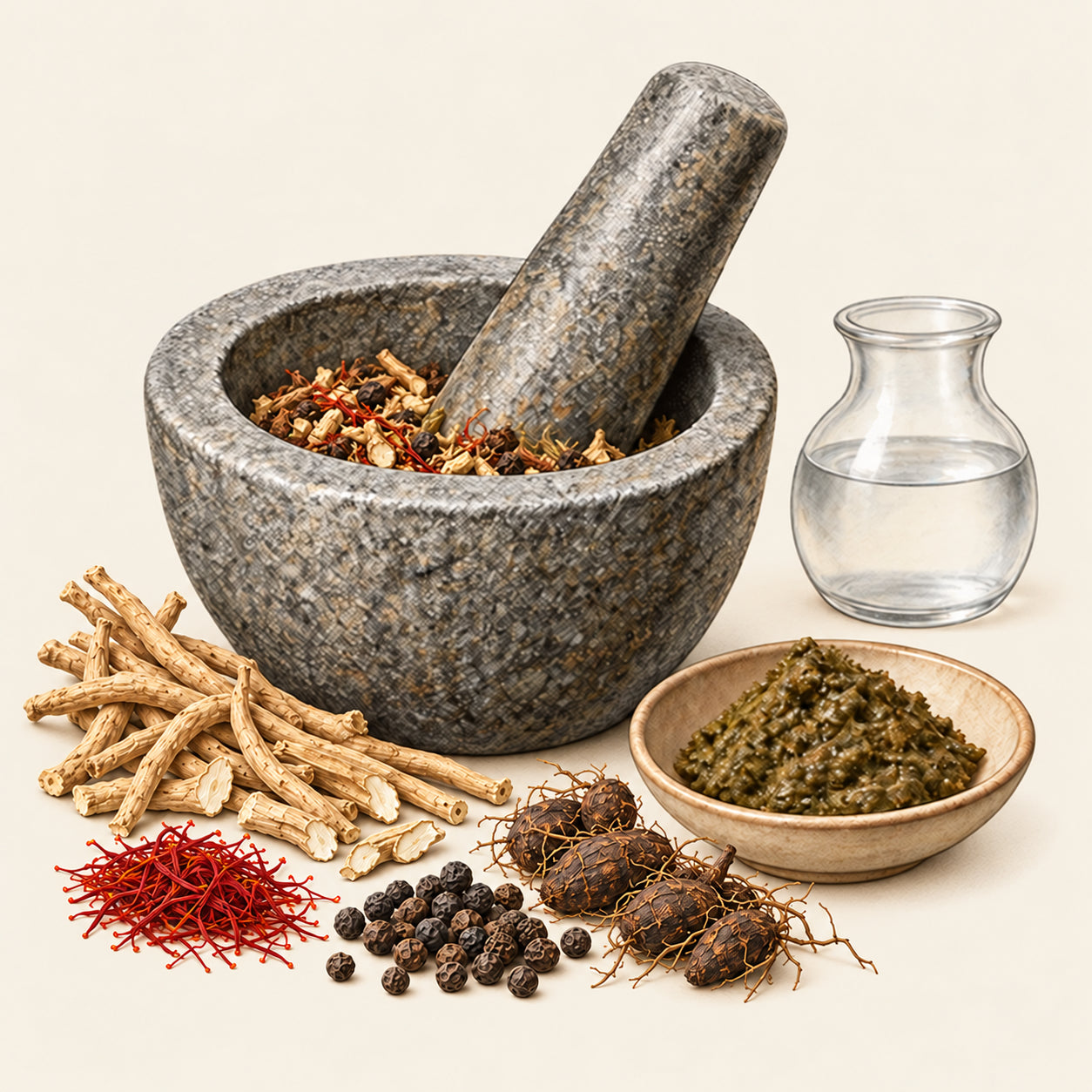
Prepare the herbs.
Herbs are prepared as a paste and a water-based decoction.
THE SCIENCEGrinding exposes more plant surface. Water draws out compounds that dissolve readily in it.

Bring them together.
Herbal paste and decoction are combined with the oil.
THE SCIENCEWater and oil favour different plant compounds. Their solubility shapes what each phase can hold.
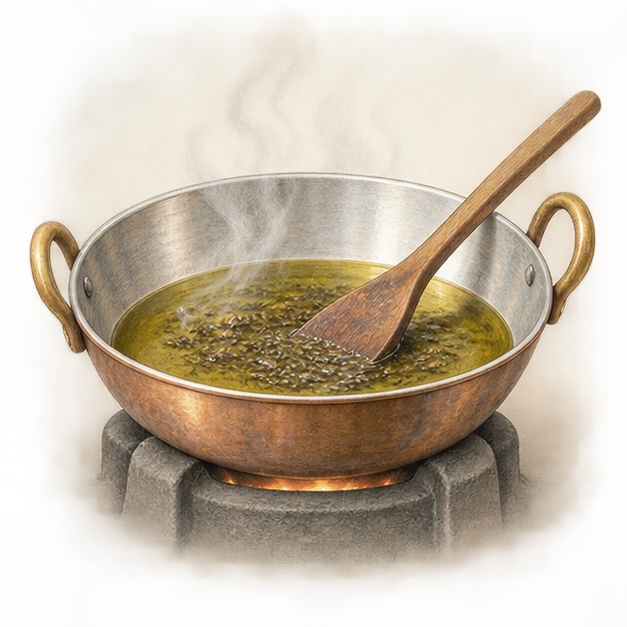
Heat with attention.
The mixture is heated gently and stirred as the water reduces.
THE SCIENCEHeat supports extraction while water evaporates. Time and temperature influence the resulting composition.
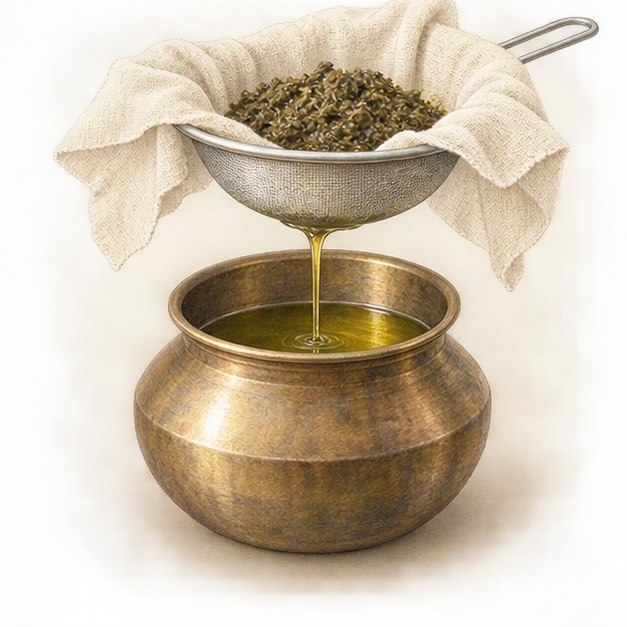
Finish, then filter.
The preparation is checked, then strained to separate the herbal solids.
THE SCIENCEFiltration removes solid residue, leaving the prepared herbal oil for formulation.

A closer look at the method
Different compounds, different solubility.
Taila Paka is part of the Ayurvedic practice of Sneha Paka. The water phase and the lipid phase interact with different constituents. Not every water-soluble compound transfers into the oil.
The process shapes the preparation.
A study of selected herbs found that using paste and decoction changed the oil’s measured chemical profile compared with paste alone. The preparation method matters.
THE CORE COLLECTION
Four causes.
Considered formulations.


FOR A CHANGING CHAPTER
From formulation
to maternity care.
Pregnancy and postpartum skin need formulations designed with particular care.
Sushenah supplies Stretch Marks Care Butter and Nipple Care Butter to Apollo Cradle Hospital, Kangaroo Care Hospital and 15+ private clinics in Bengaluru.
Explore maternity care

LESS GUESSWORK. MORE UNDERSTANDING.